
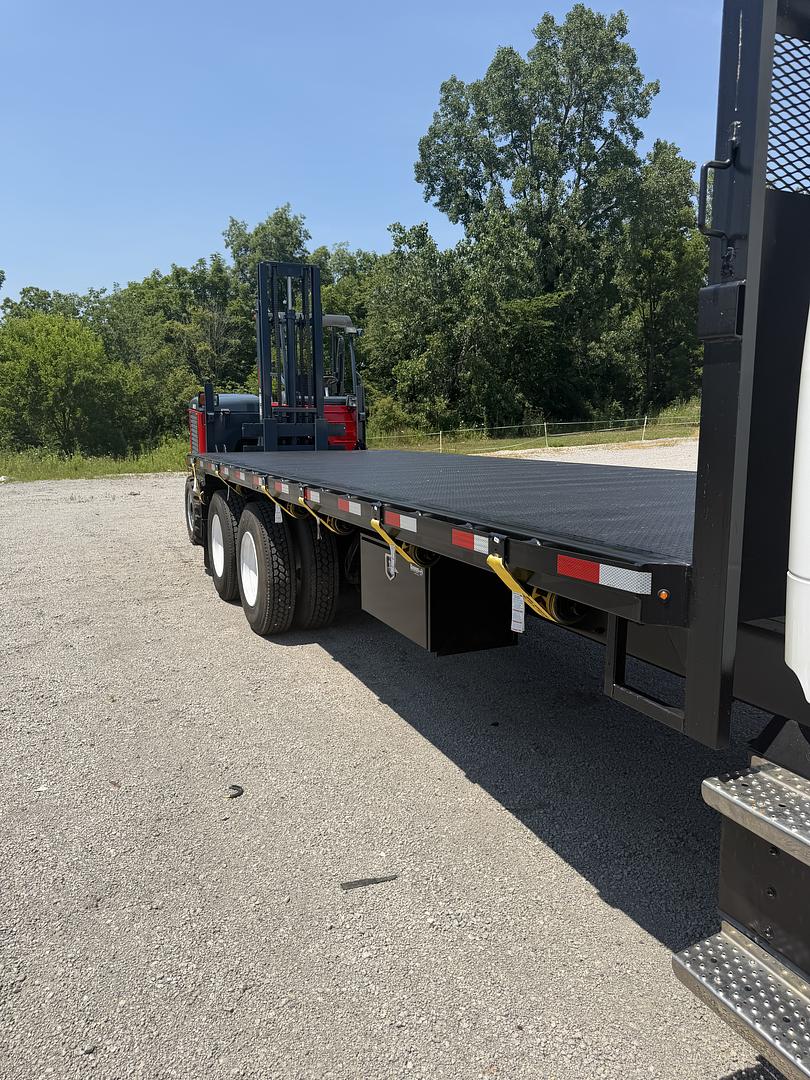
Buying a Used Moffett or Princeton Truck-Mounted Forklift: The Complete Buyer's Guide for Logistics Operators
Truck-mounted forklifts have become a staple for logistics operators who need to unload freight without waiting on a dock crew or a rented forklift. Moffett and Princeton are the two names that dominate this space, and a growing number of fleets are turning to the used market to get that capability without paying full price for new equipment.
But buying used truck-mounted forklift equipment isn't the same as buying a used pickup truck. There's mounting compatibility, hydraulic wear, and mast condition to think about — all before you even get to price. This guide walks through what to check, what questions to ask, and what red flags should make you walk away.
Why Logistics Operators Choose Truck-Mounted Forklifts
A truck-mounted (piggyback) forklift rides on the back of a flatbed or trailer and lets a single driver unload palletized freight at a site with no dock, no forklift, and no extra labor. For operators delivering to construction sites, farms, retail backdoors, or rural drops, that self-sufficiency is the whole value proposition. It cuts wait time, reduces dependency on the receiving site's equipment, and opens up delivery locations a standard flatbed simply can't service.
Moffett vs. Princeton: What's the Real Difference?
Both brands do the same core job — a forklift that mounts and dismounts from the back of a truck — but they differ in a few ways buyers ask about most:
- Mounting style: Moffett units are widely recognized for their frame-mount design and are often considered the industry benchmark, which also means used units tend to hold value well. Princeton units are generally positioned as a lower-cost alternative with a similar piggyback function.
- Parts and service network: Moffett has a longer track record in the U.S. market, so parts availability and mechanic familiarity are usually easier to find. Princeton parts can take longer to source depending on your region.
- Weight capacity ranges: Both brands offer models across similar capacity tiers (roughly 5,000–7,000 lb class), so the decision often comes down to your specific freight weight and the truck it needs to mount to.
Neither brand is a wrong answer — it comes down to what your fleet already runs, what your local techs are familiar with, and what's available in the used market at the time you're buying.
What to Inspect Before Buying Used
A used piggyback forklift takes a different kind of abuse than a standard warehouse forklift — it's exposed to the elements, mounted and dismounted constantly, and subjected to road vibration. Before buying, check:
- Hour meter and usage history — ask for maintenance records, not just the number on the meter
- Hydraulic system — look for leaks at the mast, tilt cylinders, and mounting frame connections
- Mast condition — check for bent forks, worn chains, and uneven lift/lower movement
- Mounting frame and locking mechanism — this is the part unique to piggyback units; wear here affects how securely the unit locks onto the truck
- Tires and undercarriage — road-going wear patterns differ from warehouse wear
- Engine/battery condition — depending on whether you're looking at a diesel or electric unit
If you can, get a mechanic who's specifically familiar with piggyback units to look it over — the mounting hardware is the one component a generalist forklift tech might not know to inspect closely.
Mounting Compatibility: The Detail Buyers Often Miss
Not every truck-mounted forklift bolts onto every truck. Before you buy, confirm:
- Whether the unit comes with its original mounting kit, or if you'll need a universal kit
- That the kit is rated for your specific truck's frame and hitch class
- Whether the seller can confirm the unit was previously mounted to a similar truck type
Skipping this step is one of the most common (and expensive) mistakes buyers make — a great forklift with the wrong mounting kit becomes a costly retrofit project.
What Drives Resale Pricing
Used pricing on Moffett and Princeton units varies based on:
- Model and lift capacity
- Hours and maintenance history
- Fuel type (diesel units and newer electric models price differently)
- Included mounting hardware
- Regional demand — piggyback units tend to hold value better in agricultural and rural delivery markets
Getting a quote from a dealer who specializes in this equipment (rather than a general used-truck marketplace) usually gets you a more accurate number, since general listings often underprice or overprice based on unfamiliarity with the category.
Red Flags to Walk Away From
- No maintenance records and a seller who's vague about usage
- Visible hydraulic leaks the seller downplays as "normal"
- Mounting frame damage or missing hardware
- A price that seems too low for the hour count — that's usually a sign of deferred maintenance, not a deal
- Sellers unwilling to allow an independent inspection
Bottom Line
A used Moffett or Princeton truck-mounted forklift can be one of the best investments a logistics fleet makes — but only if the mounting compatibility, hydraulics, and maintenance history all check out. Take the time to inspect thoroughly, verify the mounting kit fits your truck, and buy from a seller who can back up the equipment's history.
Looking for inspected, ready-to-mount used forklift systems? Check out our inventory to see available Moffett and Princeton units in stock.